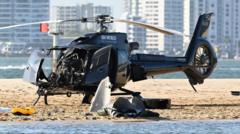
The Australian Transport and Safety Bureau (ATSB) disclosed that one of the helicopter pilots failed to receive a crucial radio call prior to the crash, highlighting how recent operational changes at Sea World diminished established risk controls. The accident transpired shortly after takeoff as one helicopter collided with another that was landing, leading to the deaths of all passengers aboard the departing helicopter.
Among the deceased were two British tourists, Diane Hughes and her husband Ron, alongside Vanessa Tadros from Sydney and pilot Ashley Jenkinson. Investigations noted that efforts by Sea World to enhance their services inadvertently created conflict points between launching and landing helicopters, complicating air traffic management.
The ATSB revealed that while the helicopter set to take off had an antenna malfunction, the pilot did not receive alerts, mistaking the airspace to be clear. As the incoming helicopter pilot focused on the landing, they failed to reassess any potential collision risks without proper radio communication. The ATSB underscored the need for diligent management of operational changes to ensure safety procedures remain robust.
The ATSB's report included multiple findings aimed at enhancing safety standards, emphasizing the necessity of thorough protocols in aviation operations. The tragedy prompts urgent reflection on aviation practices, urging operators to evaluate the possible unintended consequences of changes meant to improve safety.
Among the deceased were two British tourists, Diane Hughes and her husband Ron, alongside Vanessa Tadros from Sydney and pilot Ashley Jenkinson. Investigations noted that efforts by Sea World to enhance their services inadvertently created conflict points between launching and landing helicopters, complicating air traffic management.
The ATSB revealed that while the helicopter set to take off had an antenna malfunction, the pilot did not receive alerts, mistaking the airspace to be clear. As the incoming helicopter pilot focused on the landing, they failed to reassess any potential collision risks without proper radio communication. The ATSB underscored the need for diligent management of operational changes to ensure safety procedures remain robust.
The ATSB's report included multiple findings aimed at enhancing safety standards, emphasizing the necessity of thorough protocols in aviation operations. The tragedy prompts urgent reflection on aviation practices, urging operators to evaluate the possible unintended consequences of changes meant to improve safety.