
In brief
The European Union’s latest sanctions list has placed FIDE president Arkady Dvorkovich under a travel ban and asset freeze, prompting him to suspend his role. FIDE's leadership, long accused of Russian sway, faces scrutiny as Ukraine and allies view the move as a diplomatic victory. With Dvorkovich’s future uncertain, the chess world braces for potential leadership changes.
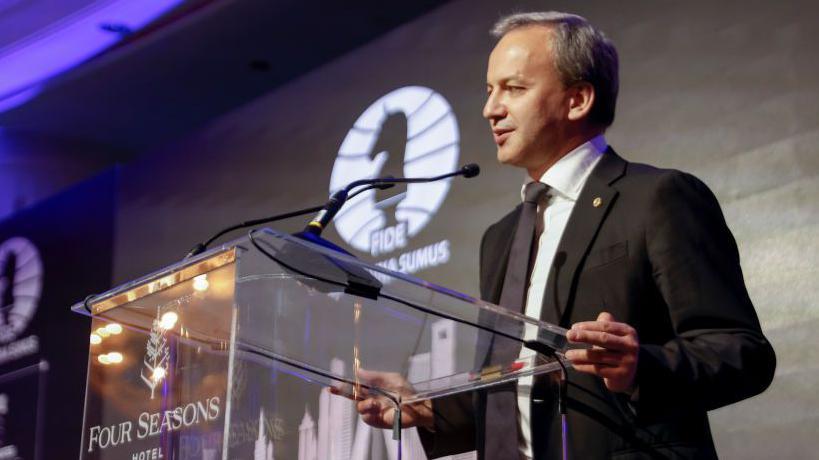
The European Union’s new sanctions list has placed FIDE president Arkady Dvorkovich under a travel ban and asset freeze, forcing him to suspend his duties but not to resign. The move has sent shock waves through the international chess community and could herald a shift in global governance.
Dvorkovich, who previously served as a deputy prime minister and Kremlin adviser, is accused of publicly supporting Russia’s annexation of Crimea and referring occupied Ukrainian cities as Russian territory. The sanctions also point to his role on the board of the Chess Federation of Russia, which has organized tournaments in occupied Ukrainian regions.
In a statement on FIDE’s platform, Dvorkovich said he was “voluntarily suspending the exercise of my powers and duties” and that the sanctions were “unlawful and unfair.” He made clear that he had not resigned from the presidency.
Ukraine’s chess officials welcomed the decision, with Volodymyr Kovalchuk calling it “an important victory” and warning that those “in favor of the aggressor” have no place in senior international roles. Malcolm Pein, England’s FIDE representative, described the sanctions as “an earthquake and a massive diplomatic victory for Ukraine”.
Dvorkovich has led FIDE since his election in 2018, a period marked by intense scrutiny on Russia’s influence in the sport. In 2024, following a push to re‑admit Russian teams and officials, a vote at the general assembly maintained sanctions against Russia and Belarus.
Kovalchuk alleges that Russia has tried to steer FIDE’s rules and voting, using the federation as a tool of soft power. Dvorkovich counters that FIDE is governed by a diverse board based in Switzerland, with executives from many countries.
With the sanctions in place, Dvorkovich’s future as FIDE president is uncertain. The chess world, which has seen a surge in viewership and sponsorship, may soon face a new era of leadership once again.
