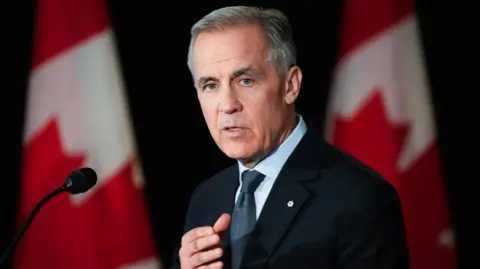
Canadian Prime Minister Mark Carney's Liberals could soon have a slim majority in the House of Commons if the party is able to make gains in three by-elections being held on Monday.
The outcome of the races - two in the Toronto area and one near Montreal - could solidify his hold on power, staving off a federal election until as late as 2029 and giving his party the ability to pass legislation without relying on support from opposition benches.
Liberals currently hold 171 of the 343 seats in the House, one shy of a technical majority.
The likely power shift comes a year after Carney became prime minister and follows a series of defections by opposition members of parliament to the Liberals.
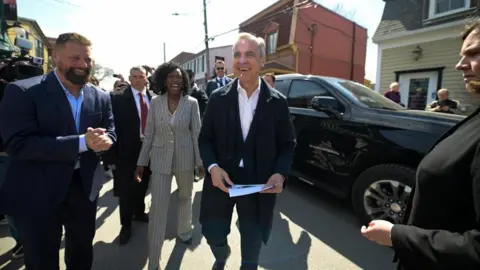
The Liberals are widely expected to win the two Toronto ridings, or constituencies, of Scarborough Southwest and University-Rosedale.
The seats were previously held by former defence minister Bill Blair - now Canada's ambassador to the UK - and Chrystia Freeland, who served as deputy prime minister under Justin Trudeau and is now an adviser to Ukraine.
The race in Terrebonne, a Montreal suburb, is considered a toss-up between the Liberals and the Bloc Quebecois.
The Liberal candidate won by a single vote in last year's federal election in April. In February, Canada's top court nullified the result over a clerical error involving a postal ballot by the federal election agency, Elections Canada.
Wins in Toronto will be enough for Carney to clinch a narrow majority. But the prime minister has already been able to shore up his bench with five defectors - four former Conservatives and one member of the left-wing New Democratic Party.
While it's not unusual for legislators to occasionally defect in Canadian politics, the recent rate of party-switching was extraordinary, said Semra Sevi, who teaches political science at the University of Toronto.
Carney has built a big tent, attracting members of parliament who would not normally be associated with the Liberal party, Sevi told the BBC.
The complication, however, is that the tent may now be so big that there isn't a lot of ideological coherence in it.
Carney has been forced to defend the most recent floor-crosser, Marilyn Gladu, who was once seen as more socially conservative and who is personally pro-life, though she said she supports access to abortion services.
Gladu has said she will vote in line with the Liberals on such issues, and Carney has said the party's values have not changed.
Polls suggest the Liberals are about 10 to 15 points ahead of the Conservatives, the official opposition, with Carney himself maintaining strong support among Canadians.
The Liberals have taken a more politically conservative shift under Carney, especially compared to Trudeau, making the party more attractive to right-of-centre MPs.
He has ended a number of signature Trudeau policies, including a consumer carbon tax, and is pushing to make Canada an energy superpower and reduce the public sector workforce.
The wave of defections has angered Conservatives, who have accused the Liberals of backroom deals.
Conservative leader Pierre Poilievre has called the floor-crossings undemocratic and has said that, by poaching MPs from other parties, Carney is telling those who elected them that your vote does not count.
But they have also raised concerns about frustration within the Conservative caucus under Poilievre, who just over a year ago was in serious contention to become the next prime minister before Carney surged ahead in the polls amid concerns about US-Canada relations under the Trump administration.
There is dissatisfaction with Poilievre's leadership style and how remote the prospect has become that Conservatives will ever form a government under him, said Sevi.
Canadian media have reported in recent days that a handful of other MPs are also being courted by the Liberals to cross the floor.
On Saturday, as Liberals gathered in Montreal for a party convention, Carney closed out the event with a speech in which he pitched unity at a time the country faces a number of crises.
Canada's founding insight is that unity does not require uniformity, he said.