In brief
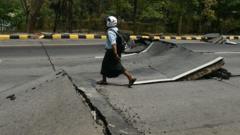
A recent 7.7 magnitude earthquake struck Sagaing, Myanmar, bringing further distress to a country already grappling with civil strife and severe food insecurity. Reports of destruction have emerged from Mandalay, the nation's second-largest city, and Nay Pyi Taw. Communication remains a challenge, with limited access to mobile and internet services complicating information flow. The nation's tumult began with a military coup in 2021 that overthrew elected leader Aung San Suu Kyi, igniting widespread protests and brutal crackdowns. This unrest has escalated into a civil war, displacing millions and worsening already dire humanitarian conditions. Following the earthquake, which struck near a rebel stronghold, local hospitals are overwhelmed with casualties, prompting the military junta to declare a state of emergency and request international assistance amid their ongoing conflict.
The article text: On Friday, Myanmar was struck by a powerful 7.7 magnitude earthquake that hit the city of Sagaing and has sent shockwaves through the already beleaguered nation. This disaster comes on the heels of a protracted civil war, an intensifying food crisis, and a struggling economy. Reports of devastation have reached nearby Mandalay, Myanmar's second-largest city, as well as Nay Pyi Taw, the capital located over 150 miles away. Gathering accurate information from Myanmar has always been a challenge due to poor communication infrastructure—mobile services are often unreliable, and many regions lack electricity, complicating internet access. Furthermore, restrictions on foreign journalists exacerbate the problem, limiting independent reporting in the country.Myanmar's troubled history can be traced back to its independence from British colonial rule in 1948, marked by decades of military rule and civil unrest. In 2011, there was a glimmer of hope when the country began to democratize, culminating in the National League for Democracy, led by Aung San Suu Kyi, winning elections in 2015. However, this progress was cut short in February 2021 when General Min Aung Hlaing led a coup, detaining Suu Kyi and her government under allegations of electoral fraud. The move sparked massive protests, which were met with severe military crackdowns that led to significant casualties and injuries among demonstrators.What began as a civil disobedience campaign soon escalated into a widespread insurgency, with armed resistance groups and ethnic rebel factions clashing with the military. Violence has persisted for four years, destabilizing the country and forcing millions into internal displacement. The military, once powerful, now struggles to maintain control, and dissent within its ranks is reportedly growing as more soldiers defect. Rights organizations reveal that as the conflict rages on, many citizens live in fear, deprived of basic necessities such as food and medical care. The UN estimates that over 3.5 million people have been displaced, a number that continues to rise alongside worsening food insecurity—marked by soaring inflation.In the wake of Typhoon Yagi, which had already caused substantial destruction earlier this year, the UN declared it would cut aid to over a million individuals in Myanmar due to global funding shortfalls. The latest earthquake has introduced a new wave of suffering to the country’s 50 million residents. As reported, the earthquake hit near Sagaing, a site of recent military conflict with rebels, resulting in air strikes that dislocated thousands. Mandalay has also been affected, where many residents face further anxiety amidst ongoing fighting.Reports from the capital suggest that one hospital has been overwhelmed with casualties, turning into a "mass casualty site" following the quake. With collapsed emergency facilities, hospitals are struggling to accommodate the influx of injured individuals. In response, the military junta has declared a state of emergency in the affected regions and made a rare appeal for international assistance. However, the junta's commitment to effectively address the devastation remains uncertain as it continues to manage an increasingly complex civil war under a weakened leadership.