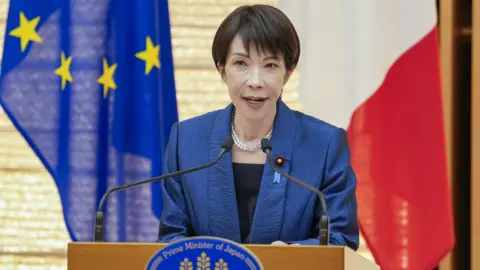
Japanese Prime Minister Sanae Takaichi will dissolve parliament on Friday, paving the way for an election next month that she hopes will give her a stronger mandate to govern. Takaichi described the decision as an extremely weighty choice that will determine Japan's future together with the people, urging voters to trust her leadership. The elections for the 465 members of the House of Representatives will occur on February 8. Since taking office in October, Takaichi's government has enjoyed high public support, reflecting her Liberal Democratic Party's (LDP) current holding of 199 seats in the House, the largest among any party. The LDP's coalition government maintains a majority, bolstered by a partnership with the Japan Innovation party.
Takaichi, an admirer of Margaret Thatcher and known as Japan's Iron Lady, has drawn attention for her record nine trillion yen defense budget approved by her cabinet in December, addressing concerns about military activities from China, deemed a significant strategic challenge. Her stance on recent regional security issues has drawn ire from China, particularly following her comments suggesting Japan might strengthen its self-defense capabilities in response to threats to Taiwan. This has led to a notable diplomatic fallout, affecting bilateral relations.
Amidst a backdrop of strong public approval ratings between 60-80%, Takaichi faces challenges due to a new consolidated opposition formed by Japan's largest party, the Constitutional Democratic Party of Japan, and its former coalition partner, Komeito. The upcoming election could reshape the political landscape as Takaichi seeks to avoid history repeating itself, recalling the poor results of her predecessor who also called for a snap election shortly after taking office. With the political environment shifting, her gamble presents both opportunities and significant risks for her leadership.
Takaichi, an admirer of Margaret Thatcher and known as Japan's Iron Lady, has drawn attention for her record nine trillion yen defense budget approved by her cabinet in December, addressing concerns about military activities from China, deemed a significant strategic challenge. Her stance on recent regional security issues has drawn ire from China, particularly following her comments suggesting Japan might strengthen its self-defense capabilities in response to threats to Taiwan. This has led to a notable diplomatic fallout, affecting bilateral relations.
Amidst a backdrop of strong public approval ratings between 60-80%, Takaichi faces challenges due to a new consolidated opposition formed by Japan's largest party, the Constitutional Democratic Party of Japan, and its former coalition partner, Komeito. The upcoming election could reshape the political landscape as Takaichi seeks to avoid history repeating itself, recalling the poor results of her predecessor who also called for a snap election shortly after taking office. With the political environment shifting, her gamble presents both opportunities and significant risks for her leadership.