
In brief
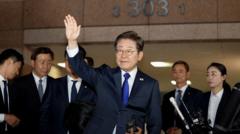
South Korea's newly elected president, Lee Jae-myung, enters office during a tumultuous transition following the impeachment of his predecessor, facing significant economic and security challenges, particularly regarding relations with the U.S. and North Korea.
South Korea's freshly elected president, Lee Jae-myung, has taken office under precarious circumstances, quickly facing daunting challenges rather than enjoying the customary transition period. His predecessor, Yoon Suk Yeol, was impeached last December for attempting to impose martial law, leaving Lee to fill the leadership void without delay. Garnering nearly 50% of the popular vote, Lee represents a firm rejection of authoritarian practices and promises to restore democracy and unify the nation after months of political division.However, Lee’s inaugural days are overshadowed by a looming crisis shaped like former U.S. President Donald Trump. The new administration must confront Trump’s previous imposition of extensive tariffs on Korean goods, which, if reinstated, could precipitate an economic calamity for South Korea already contending with a slowing economy.Negotiations with Trump have stalled, and with Lee now in office, they cannot be postponed further. Crucial to this dialogue is the U.S. military's ongoing commitment to South Korean defense amid tensions with North Korea, which has become increasingly unstable under Kim Jong Un’s rule. Trump is likely to intertwine trade with security agreements, complicating the situation for Lee, who favors bolstering ties with China.Concerns mount that Trump may leverage military protection in exchange for financial commitments from Seoul, despite Seoul’s reservations. Compounding the situation is Washington’s shifting focus towards China, leading to speculation about the potential reduction of U.S. troop presence in the region, with implications for South Korea’s defense posture against the North.Lee, known for a skeptical stance towards the U.S.-Korea alliance, is in a precarious situation, wanting to promote amicable relations with China while simultaneously assuring the U.S. of South Korea’s strategic value. The dynamic between Lee and Trump may prove challenging, potentially destabilizing peace in Northeast Asia.On top of these geopolitical concerns, North Korea's ambitions and military advancements remain critical factors, with Pyongyang’s nuclear program posing an increasing threat. The encouragement from allies such as Russia allows Kim greater room for negotiation, leading to fears that any future discussions with Trump could disregard South Korea’s security interests.As Lee engages in his presidency, it is imperative that he establishes a clear dialogue with the U.S. and imparts to Trump the significance of South Korea as an essential partner. The stakes are perilously high, and the new president faces pressure to respond swiftly to secure South Korea’s position both economically and militarily in this evolving landscape.With South Korea's shipbuilding prowess, Lee seeks to demonstrate industry's capabilities to reinforce ties with the U.S. However, as Trump’s transactional approach looms large, Lee's quick strategic decisions will determine the future stability of South Korea's democratic values and security in an increasingly complex geopolitical arena.
