In brief
Weeks after a fragile ceasefire in Gaza, the region experiences renewed economic struggles alongside ongoing discussions regarding disarmament and reconstruction. As attention shifts to the conflict with Iran, local residents express despair over their lost situation. Officials warn of potential escalations with Hamas rejecting proposals that could stabilize the region.
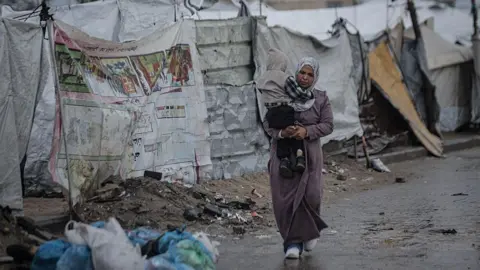
Nearly six months after a fragile ceasefire came into force in Gaza, Palestinians in this war-torn territory are still struggling. In the markets, there are again shortages of some goods and rising prices, with merchants citing disruptions in supplies brought in from Israel due to the new war in the region. A local shopper remarked, What does the war between Iran and Israel have to do with us? Prices have doubled here. Goods aren't coming in like before.While the global attention has turned to the conflict with Iran, uncertainty looms over Gaza amid President Trump's 20-point peace plan. Recently, the High Representative for Gaza on the US-led Board of Peace, Nickolay Mladenov, outlined a plan for Palestinian armed groups to decommission their weapons, linking this compliance to the reconstruction effort.However, insiders suggest Hamas, whose October 2023 attack on Israel sparked this renewed conflict, is likely to reject these proposals. This raises the specter of a possible military response, as Israeli officials demand Hamas disarm, either easily or forcefully.Despite soaring food prices and economic strife—exacerbated by heavy rain causing sewage problems in crowded camps—aid from the Trump administration has not materialized as promised. Humanitarian agencies lament the slow progress in recovery, emphasizing the dire need for reconstruction materials and infrastructure rehabilitation. As Gazans express frustration at the continuing rise of prices due to heavy taxation imposed by Hamas and other local governance challenges, the situation remains fraught with tension. Ensuing efforts to stabilize Gaza are further complicated as Israeli airstrikes continue, with casualties reported among civilians amidst ongoing hostilities.While some hope the newly formed technocratic committee could signal a shift towards recovery, there are significant concerns about trust, oversight, and the feasibility of international aid and governance as focus drifts towards the broader geopolitical crisis with Iran.