
In brief
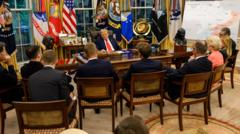
The Oval Office map highlighting Russian-occupied territories in Ukraine plays a crucial role in shaping President Trump's views during his talks with Ukrainian President Zelensky. While the map serves as a stark reminder of territorial losses, Zelensky emphasizes the importance of reclaiming these areas, leading to differing perspectives on territory and strategy.
The conflict between Ukraine and Russia continues to be marked by a stark visual representation in the Oval Office. A significant map depicting regions under Russian control was prominently displayed during President Donald Trump’s meeting with Ukrainian President Volodymyr Zelensky. This visual aid, shaded in red to illustrate occupied territories, conveyed an unmistakable message about the extent of Russian occupation, which currently encompasses a fifth of Ukrainian land."I assume you've all seen the map," Trump remarked in a subsequent interview, highlighting the alarming territory loss faced by Ukraine. His statements suggested a readiness to discuss potential compromises with Russian President Vladimir Putin over these territories. Zelensky’s team presented a contrasting viewpoint, insisting on the importance of accurate territorial data and the need to challenge the notion of surrendering land to Russian control.The discussions highlighted the ongoing debate between understanding the immediate realities on the ground and the long-term implications of ceding territory. Zelensky pointed out the percentages reflecting Russian control across several regions, emphasizing that the contested Donbas area remains predominantly in Russian hands. Despite the setbacks, he argued that recent data indicates minor advancements by Russia—occupying less than 1% of Ukraine’s territory in the last 1,000 days.Amidst this complex landscape of military strategy and territorial integrity, analysts stress that Russia's control is met with challenges. Ukraine continues to defend key areas and has successfully repelled some Russian advances near certain strategic points. However, the ongoing conflict reveals a troubling picture, with Russian forces managing to recruit additional soldiers and build reserves, potentially leading to a protracted struggle.As discussions evolve, both leaders remain entrenched in their respective positions. Zelensky acknowledged the map’s relevance despite their differing perspectives, demonstrating the high stakes of their negotiation efforts. As the war progresses, the implications of territorial maps and control will undoubtedly play a vital role in shaping the future of Ukraine and its people.
