

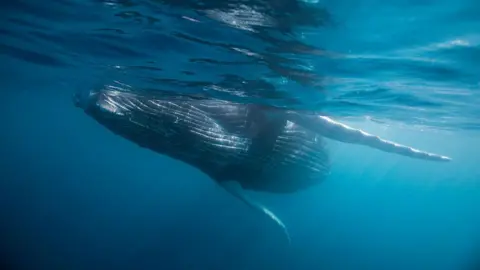
A colossal whale graveyard—stretching 1,200 kilometres (about 745 miles) long and lying 7 kilometres (four miles) below the surface—has been uncovered in the south‑eastern Indian Ocean’s Diamantina fracture zone, a rugged seafloor region of ridges and trenches.
The discovery was made by an international team of oceanographers from China, Italy and New Zealand, who spent 32 dives collecting samples from 485 sites and active whale falls. Their work revealed a treasure trove of fossils, including a 5.3‑million‑year‑old beaked whale skull and a five‑metre Antarctic minke whale carcass, the largest specimen yet found at such depths.
“Discovering a necropolis of this scale was completely unexpected,” said Xiaotong Peng of the Chinese Academy of Sciences. “The size of distribution, the depth and the age range were far beyond anything we had imagined.”
The underwater necropolis teems with organisms—jellyfish, worms, crustaceans and other deep‑sea fauna—which researchers say “may be new to science.” Their observations were published in the journal Nature, highlighting the site’s potential to reshape our understanding of deep‑sea ecosystems.
During the dives, scientists identified a new whale species, named Pterocetus diamantinae after the discovery site, adding to the growing list of deep‑sea megafauna known only from the fossil record.
“Although the site has limited accessibility, it seems likely to hold many other exciting finds,” noted Stephen J Godfrey of the Calvert Marine Museum. “This discovery will no doubt inspire more submersible dives in similar environments.”
The unexpected find underscores the importance of underwater archaeology and sets the stage for future expeditions to explore deeper, uncharted trenches across the world’s oceans.


