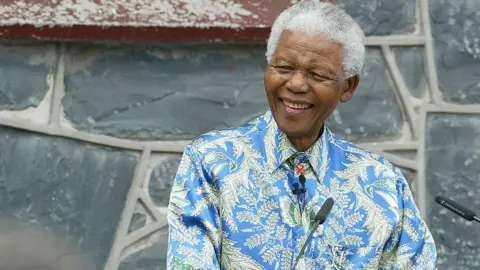
A South African court has dismissed an appeal by the country's heritage body to stop the sale and export of various artefacts connected to anti-apartheid hero Nelson Mandela. The 70 personal items include a cell key from Robben Island, where Mandela was imprisoned for 18 of the 27 years he was locked up, a pair of Aviator sunglasses, and one of his signature floral shirts, which are set to be auctioned in the US.
These artefacts belong to Mandela’s eldest daughter, Makaziwe Mandela, and Christo Brand, a Robben Island warden during Mandela's incarceration. Efforts to halt the sale were made by the South African Heritage Resources Agency (Sahra), which argued that the items are culturally significant and should remain in the country. However, the Supreme Court of Appeal stated that Sahra’s interpretation of heritage law was overly broad, allowing the sale to proceed.
Mandela's daughter plans to use the proceeds from the auction to create a memorial garden at her father’s grave in Qunu, Eastern Cape. While some support her family's right to decide the fate of these items, others contend that they should be preserved for future generations in South Africa. The ongoing debate highlights the complexities surrounding cultural heritage as it intersects with personal ownership and public interest.
These artefacts belong to Mandela’s eldest daughter, Makaziwe Mandela, and Christo Brand, a Robben Island warden during Mandela's incarceration. Efforts to halt the sale were made by the South African Heritage Resources Agency (Sahra), which argued that the items are culturally significant and should remain in the country. However, the Supreme Court of Appeal stated that Sahra’s interpretation of heritage law was overly broad, allowing the sale to proceed.
Mandela's daughter plans to use the proceeds from the auction to create a memorial garden at her father’s grave in Qunu, Eastern Cape. While some support her family's right to decide the fate of these items, others contend that they should be preserved for future generations in South Africa. The ongoing debate highlights the complexities surrounding cultural heritage as it intersects with personal ownership and public interest.