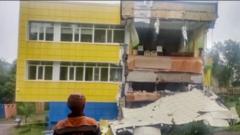
A devastating 7.2 magnitude earthquake struck Central Mexico at 5:18 AM local time on [Current Date], triggering widespread panic and critical damage across the region. The epicenter, located 45 kilometers east of the Pacific coast town of Puerto Escondido in Oaxaca state, sent shockwaves through Mexico City and beyond, with tremors felt as far as Guatemala. According to the US Geological Survey, the quake originated at a shallow depth of 10 kilometers—amplifying its destructive force—and registered 7.2 on the Richter scale. The Mexico City Metro system reported multiple service disruptions, while hospitals in Puebla and Tlaxcala activated emergency protocols for hundreds of injured patients.
Tsunami warnings were immediately issued by Mexico’s National Institute of Oceanography and the Pacific Tsunami Warning Center, with wave heights of 1.5 meters recorded near the coast. Authorities have confirmed 12 fatalities in Oaxaca, including five in the village of Salina Cruz, where collapsed buildings trapped dozens of residents. Over 500 people have been injured, with 200 requiring urgent medical attention. Emergency responders are currently staging at 27 locations across the affected states, deploying 4,000 personnel and 100 ambulances to rescue stranded communities.
The Mexican government has declared a 'Level 4' emergency, suspending public transport and activating all national emergency protocols. President López Obrador addressed the nation at 7:45 AM, stating, 'This is an unprecedented challenge for our nation, but we are mobilizing every resource to protect lives.' Meanwhile, international aid teams from the US Geological Survey and the Red Cross have begun coordinating with Mexican authorities.
This earthquake marks the first significant seismic event of 2023 in the Central American region, raising concerns about heightened tectonic activity along the Pacific Ring of Fire. Scientists warn that further aftershocks are expected in the coming hours. Residents are urged to remain vigilant, monitor official communications, and avoid coastal areas until further notice. The situation remains fluid as emergency operations continue.}
Tsunami warnings were immediately issued by Mexico’s National Institute of Oceanography and the Pacific Tsunami Warning Center, with wave heights of 1.5 meters recorded near the coast. Authorities have confirmed 12 fatalities in Oaxaca, including five in the village of Salina Cruz, where collapsed buildings trapped dozens of residents. Over 500 people have been injured, with 200 requiring urgent medical attention. Emergency responders are currently staging at 27 locations across the affected states, deploying 4,000 personnel and 100 ambulances to rescue stranded communities.
The Mexican government has declared a 'Level 4' emergency, suspending public transport and activating all national emergency protocols. President López Obrador addressed the nation at 7:45 AM, stating, 'This is an unprecedented challenge for our nation, but we are mobilizing every resource to protect lives.' Meanwhile, international aid teams from the US Geological Survey and the Red Cross have begun coordinating with Mexican authorities.
This earthquake marks the first significant seismic event of 2023 in the Central American region, raising concerns about heightened tectonic activity along the Pacific Ring of Fire. Scientists warn that further aftershocks are expected in the coming hours. Residents are urged to remain vigilant, monitor official communications, and avoid coastal areas until further notice. The situation remains fluid as emergency operations continue.}