
In brief
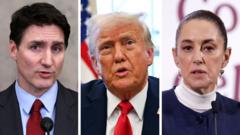
President Trump has delayed imposing tariffs on Mexico and Canada, following negotiations that resulted in commitments from both countries to strengthen border security and combat drug trafficking. While Trump claims a victory for his "America First" policy, Canadian Prime Minister Trudeau and Mexican President Sheinbaum have also secured political wins. The outcome raises questions about future trade relations and the implications for businesses in North America.
President Donald Trump has opted to pause for 30 days the anticipated tariffs on Mexico and Canada following intense negotiations with the two countries. This move allows Trump to tout progress in tightening border security and curbing crime, presenting it as a win for his administration. However, both Canadian Prime Minister Justin Trudeau and Mexican President Claudia Sheinbaum also emerged with significant political gains amid this trade conflict that poses potential economic repercussions across North America.According to various reports, Trump’s tough stance appears to have borne fruit, as both neighboring countries have committed to increased measures for border enforcement and addressing the trafficking of fentanyl. This turn of events temporarily alleviates the potential economic disruption that a trade war could cause, giving Trump some breathing room to advance domestic-oriented initiatives without directly harming American consumers.Historically, Trump has used tariffs as a tactical mechanism in trade negotiations, a strategy that has previously drawn backlash from both Canada and Mexico. This latest iteration threatens sweeping tariffs, extending even to China, which faces its own tariff hikes. Concerns linger, however, regarding Trump’s intentions beyond the grace period he has set, as businesses may become hesitant to invest or make employment decisions in an environment filled with uncertainty.From Canada, analysts express a collective relief as the threat of tariffs loomed unpredictably over economic stability. Trudeau, in his role as a temporary lame-duck leader, gained ground by showcasing a proactive stance toward U.S. demands and was able to highlight existing measures to combat drug trafficking and border security, presenting a solid front to Trump’s administration.On the Mexican side, President Sheinbaum showcased diplomatic prowess during the ongoing trade tension. Her assurances to send National Guard troops for fentanyl control proved effective in negotiating a temporary tariff suspension. Additionally, she successfully redirected attention to the issue of arms trafficking from the U.S. into Mexico, which has exacerbated cartel violence. Sheinbaum's adept handling of the negotiations grants her administration crucial time to further deliberate over committed measures while mitigating immediate trade threats.Looking ahead, observers speculate that Secretary of State Marco Rubio may soon travel to Mexico to discuss cooperative strategies related to the agreements reached. As both Trudeau and Sheinbaum navigate these negotiations, their evolving relationships with the Trump administration will be pivotal in shaping future trade dynamics and overall North American cooperation.

